5min read

Authors
Conrad Schoo
Rania Belkahia
We backed some of the defining marketplaces of the last decade. Handshake built one of the largest early talent networks in the US, fundamentally changing how a generation of students access opportunity and how employers find their next hire. Wolt turned food delivery into a premium consumer experience across dozens of markets, and became one of Europe's most celebrated exits. Vinted redefined second-hand commerce at global scale, building one of the most efficient and trusted peer-to-peer marketplaces in the world. We know what a great marketplace looks like. And right now, something is shifting.
The old marketplace model has been under pressure
The first wave of internet marketplaces created enormous value, but the underlying economics were always fragile. Customer acquisition was expensive, retention was hard as buyers and sellers learned to transact directly, and take rates stayed thin because the core product, pure matching, was difficult to defend. The model worked when custom curation and network effects were strong enough to carry the business. The best platforms built trusted, vetted supply that buyers couldn't easily replicate elsewhere. That curation edge can now be run better and faster at close to zero marginal cost, leaving legacy platforms exposed to disruption risk.
From matchmaker to operator
The new generation of marketplaces must go beyond curation and matchmaking. They draft the proposal, score the candidates, benchmark the price, and run the compliance check. The platform is now embedded in the transaction itself, and goes beyond a simple introduction.
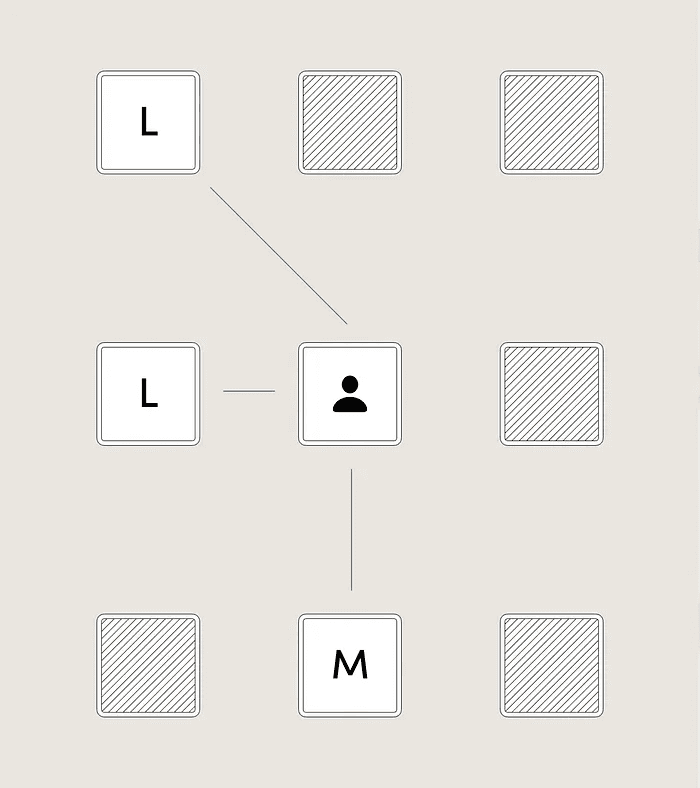
The degree of embedding varies, and so does the resulting platform stickiness. At one end, pure brokers match supply and demand, leading to high disintermediation risk and thin moats. At the other end, embedded platforms run the customer's core operations, making churn nearly impossible. Financing and white-label models sit in between, each trading off brand risk or underwriting complexity for greater lock-in.
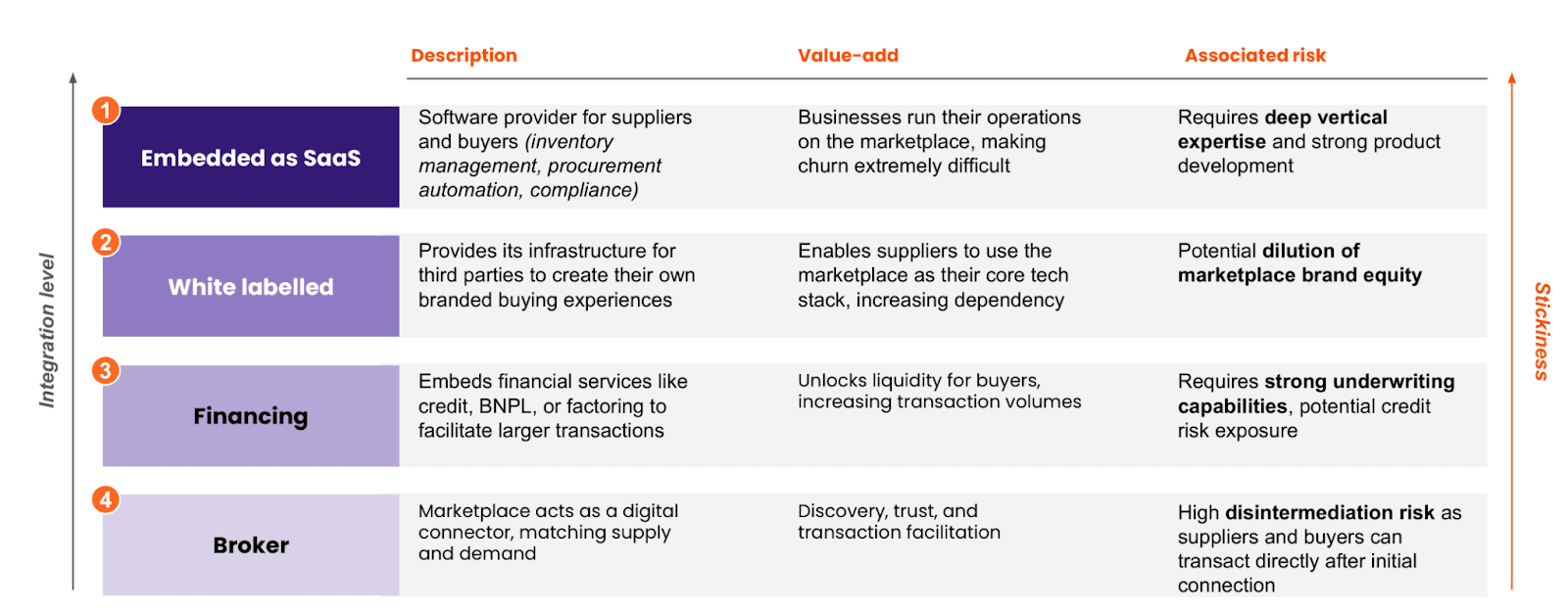
EQT view - Four marketplace archetypes by integration level and stickiness
Instead of taking a cut of GMV, these platforms often charge for outcomes: a hire made, a tender won, a shipment cleared. And the competitive dynamic shifts too. The real alternative is no longer another platform, but the internal team or process the customer has been running themselves.
New moats, new economics
Traditional marketplace models were typically constrained by a supply-demand-mismatch, where liquidity became a key value proposition. Get enough buyers and sellers in one place and the platform becomes hard to displace. With the new generation of marketplaces, every transaction accelerates supply build-out via AI-assisted onboarding, improves buyer-seller matchmaking, and raises the costs of churning from the platform.
The resulting unit economics also look different. When a platform handles execution end to end, buyers and sellers have far less reason to bypass it; disintermediation becomes harder and logo retention improves. Automated intake and more precise matchmaking also reduce the cost of acquiring and activating new participants. Lower CAC, lower churn, and higher repeat usage compound into an LTV:CAC ratio that the first generation of marketplaces rarely achieved.
Where we see new models emerging
AI is unlocking entirely new business models in markets that have been waiting for a better solution. We are actively looking at opportunities like these:
Recruiting and talent. Sourcing, screening, and running interviews autonomously, charging for the hire rather than the listing. The whole recruitment process becomes a managed service.
Public tenders. Billions in public contracts go uncaptured every year because the process of finding, evaluating, and responding to tenders is operationally heavy. A platform that scans continuously, scores relevance, and drafts the bid turns this into an accessible market for the first time.
Logistics and freight. Beyond connecting shippers and carriers, handling routing, exceptions, and customs documentation in real time. The platform compounds on routing decisions, exception handling, and carrier performance data.
SMB insurance: Handling risk assessment, policy sourcing, and claims coordination and compounds on loss data over time.
Skilled trades: Enabling lead qualification, job scoping, materials procurement, and payment for plumbers, electricians, and contractors.
Healthcare operations. Matching on outcomes, availability, and patient need to bring consistency and speed to healthcare ops.
If you're building the next generation of marketplaces, we want to hear from you!
rania@eqtventures.com
conrad.schoo@eqtventures.com
More to read
20 articles